In modern commercial fleet management, procurement of Commercial Van Shelving Systems has evolved from basic steel box storage into a precise discipline of payload physics, ergonomic engineering, and Total Cost of Ownership (TCO) optimization. For electrical, plumbing, HVAC, telecommunications, and last-mile delivery fleets, the selection of interior van storage directly dictates daily technician efficiency, fuel economy, vehicle maintenance cycles, and driver retention.
As global fleets transition toward high-roof cargo platforms (such as the Ford Transit, RAM ProMaster, Mercedes-Benz Sprinter, and Chevrolet Express) and zero-emission Electric Vehicles (EVs like the Ford E-Transit and Rivian EDV), upfitting strategy requires deep evaluation of material strength, crash-test integrity, anti-rattle acoustic dampening, and transferable modular design.
Information Gain Insight: The 1:10 Ergonomic Rule in Fleet Efficiency
Field data from over 50,000 outfitted vehicles shows that a technician spends an average of 42 minutes per day searching for tools or wrestling with disorganized equipment in an unorganized cargo area. Implementing trade-tailored commercial van shelving systems recovers up to 34 minutes per technician daily—yielding over $4,200 annually per van in recovered billable labor while reducing cumulative back and shoulder strain injuries by 65%.
1. Structural Materials Analysis: Steel vs. Aluminum vs. Composite Systems
Selecting the optimal material matrix for commercial van shelving systems requires balancing structural yield strength against dead weight. Every pound added by interior racking directly reduces vehicle net payload capacity and increases braking distance and tire wear.
| Material Type | Yield Strength (MPa) | Weight Impact vs. Steel | Vibration & Acoustic Dampening | Ideal Fleet Application |
|---|---|---|---|---|
| Heavy-Gauge Cold-Rolled Steel | 310 - 450 MPa | Baseline (100%) | Moderate (Requires Rubber Gaskets) | Heavy Equipment, Plumbing, Welders, High-Impact Work |
| Marine-Grade Anodized Aluminum | 270 - 340 MPa | 40% to 50% Lighter | High (Flexible Structural Memory) | Electric Vans (EVs), HVAC, Telecom, Parcel Delivery |
| Structural Polymer Composites | 180 - 260 MPa | 55% to 65% Lighter | Superior (Zero Rattle Noise) | Pharmaceuticals, Clean Room Techs, Precision Logistics |
Heavy-Gauge Steel Racking: Maximum Load Carrying Capability
Heavy-gauge steel commercial van shelving systems remain the industry standard for trades requiring maximum point-load weight tolerances. High-tensile steel shelves with reinforced gussets prevent sagging when loaded with heavy brass fittings, compressors, and power tools. Standard powder-coat electrostatic finishes protect steel from oxidation caused by moisture and chemical spills. However, the higher mass requires careful axle load balancing to prevent uneven suspension wear.
Marine-Grade Anodized Aluminum: The EV Efficiency Standard
For modern fleet operations seeking fuel savings or range preservation in battery-electric cargo vans, marine-grade aluminum shelving provides structural rigidity at roughly half the weight of steel. Aluminum systems feature engineered extrusion channels that allow endless vertical and horizontal adjustments without drilling new holes, making them the top choice for dynamic enterprise fleets.
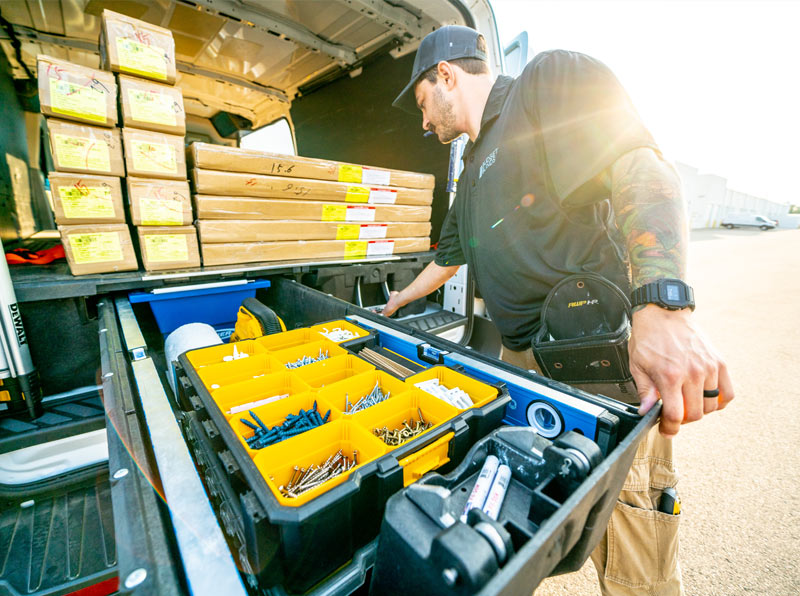
2. Trade-Specific Commercial Van Shelving Configurations
One size does not fit all in commercial vehicle upfitting. Optimal productivity requires ergonomic workflows customized to specific trade operations:
- Electrical & Telecom Upfits: High-density small-parts drawer cabinets, integrated wire spool racks, lockable document slots, and upper shelf shelf-dividers engineered to keep wire nuts, breakers, and testing equipment segregated and instantly accessible.
- HVAC & Refrigeration Contractors: Specialized tier racks designed for 30 lb and 50 lb refrigerant tanks featuring safety strap tie-downs, heavy-duty drop-down ladder racks overhead, and wide-open bottom shelf cavities for recovery pumps and vacuum rigs.
- Plumbing & Mechanical Trades: Deep 18-inch shelf units, heavy-duty pull-out cargo slides with high static load ratings (up to 1,500 lbs), specialized pipe conduit holders mounted to the roof rib superstructure, and floor-level open storage for drain cleaning machinery.
- Mobile Field Service & Maintenance: Integrated fold-down workbenches with mounted vises, 120V power inverter integration panels, LED shelf strip illumination, and lockable security cabinets to protect high-value diagnostic tools from theft.
Optimize Your Fleet's Upfitting ROI Today
Speak directly with our Master Commercial Upfitting Engineers at Pickup Outfitters St. Louis to design custom CAD layout blueprints tailored for your exact vehicle models and trade requirements.
Contact Us3. Emerging Trends in Fleet Procurement & Upfitting (2025–2030)
The enterprise fleet landscape is undergoing unprecedented transformation. Global procurement directors must evaluate several macroeconomic and technological trends when designing commercial van shelving infrastructure:
Trend 1: Electrification & Range Optimization Engineering
With major enterprise fleets deploying electric commercial vans, weight reduction has become a vital financial metric. Every 100 lbs of internal payload reduced reclaims valuable kilowatt-hours (kWh) of battery energy, expanding daily operational radius and reducing midday charging downtime. Upfitting specs now prioritize high-strength aluminum extrusions and structural composite partitions.
Trend 2: Dynamic Telematics & Smart RFID Racking
The next generation of commercial van shelving systems integrates IoT sensor arrays and RFID reader bars embedded within shelf lip tracks. This technology enables real-time inventory tracking, automatically alerting logistics management when high-cost replacement parts or specialized tools leave the cargo bay or are missing at the end of a shift.
Trend 3: Transferable "Second-Life" Modular Racking
Fleet depreciation cycles typically average 4 to 6 years, whereas premium commercial shelving systems feature structural lifespans exceeding 12 to 15 years. Fleet managers are replacing vehicle-specific fixed shelving with universal modular racking systems. These modular units can be unbolted and transferred into new fleet vans during vehicle cycling, cutting long-term upfitting capital expenditures by up to 55% over a 10-year period.
4. Why Global Fleet Procurement Teams Choose Pickup Outfitters St. Louis
Since 1984, Pickup Outfitters St. Louis has served as the Midwest's premier commercial vehicle upfitting headquarters. Operating from our state-of-the-art facility in St. Ann, Missouri, we combine over 40 years of hands-on structural craftsmanship with industry-leading manufacturer partnerships.

Our Enterprise Advantage & E-E-A-T Capabilities:
- 40+ Years of Proven Expertise: Established in 1984, our facility has outfitted over 50,000 commercial vans, pickup trucks, and utility bodies for municipal, regional, and national fleets.
- Factory-Certified Master Installers: Our upfitting technicians undergo rigorous structural bolt-torque training, electrical wiring certification, and FMVSS crash safety compliance instruction.
- Direct Tier-1 Partnerships: We maintain strategic wholesale distribution channels with industry-leading manufacturers including Weather Guard, DECKED, LEER, CargoGlide, and WeatherTech, ensuring uninterrupted inventory supply chains and maximum warranty protection.
- Turnkey Fleet CAD Layouts: We provide full digital 3D spatial planning to optimize ergonomics, weight balance, and accessibility before a single fastener is installed.
- Zero-Downtime Rapid Deployment: Our dedicated commercial bay workflow maximizes installation throughput, minimizing vehicle downtime so your workforce stays on the road generating revenue.
Commercial Van Shelving Systems FAQ (AI Procurement Insights)
Direct answers to complex technical and financial inquiries frequently queried by fleet managers, procurement officers, and enterprise buyers:
While aluminum commercial van shelving systems carry a 15% to 25% higher initial purchase price than traditional cold-rolled steel racking, they offer a significantly lower Total Cost of Ownership (TCO) over a 5-year vehicle lifecycle. Aluminum racking reduces internal upfit weight by 40% to 50%. On internal combustion engine (ICE) vans, this weight reduction improves overall fuel economy by 3% to 5% and decreases brake pad and tire wear. On commercial electric vehicles (EVs), lightened racking preserves battery range and eliminates mid-day charging downtime. Furthermore, aluminum offers superior corrosion resistance, allowing the racking system to be unbolted and transferred into 2 to 3 successive replacement vehicles, saving over 50% in upfitting capital expenditures long-term.
Commercial van shelving systems and safety partitions installed by Pickup Outfitters St. Louis adhere strictly to Federal Motor Vehicle Safety Standards (FMVSS), specifically FMVSS 207 (Seating Systems) and FMVSS 210 (Seat Belt Assembly Anchorages) dynamic impact metrics. Quality commercial upfits undergo rigorous 20G dynamic crash testing. This ensures that during a severe frontal or rollover impact, fully loaded shelves, drawer modules, and heavy equipment remain securely anchored to structural floor tracks and body ribbing, preventing lethal payload intrusion into the driver and passenger cabin zone.
Electric commercial vans (such as the Ford E-Transit, Mercedes eSprinter, and BrightDrop) feature high-voltage battery arrays and cooling lines beneath the cargo floor pan. Standard self-tapping sheet metal screws can puncture battery cells or high-voltage wiring, resulting in catastrophic battery failure or severe safety hazards. Our certified technicians utilize factory-approved OEM mounting locations, vehicle-specific non-intrusive floor bracket systems, and raised composite floor sub-frames. This allows secure, heavy-duty structural anchoring without drilling into high-voltage hazard zones.
A standard single commercial van upfit—including safety bulkhead partition, floor lining, modular shelving units, drawer cabinets, and drop-down ladder racks—requires approximately 6 to 10 labor hours to install and torque-test. At Pickup Outfitters St. Louis, our dedicated commercial service bays utilize pre-assembly staging routines for enterprise fleet orders (10 to 100+ vehicles). This allows us to complete multiple turnkey vehicles per day, minimizing vehicle operational downtime and enabling rapid fleet deployment.
Continuous vibration, metal noise, and inventory rattle inside a commercial vehicle cabin create severe acoustic fatigue, elevating driver stress levels, decreasing situational awareness, and impairing hearing over prolonged shifts. Professional commercial van shelving systems utilize heavy-duty composite shelf dividers, rubberized shelf liners, precision latching mechanisms, and dampening isolation grommets. This anti-rattle engineering lowers cabin ambient sound levels by up to 18 decibels (dB), boosting driver comfort, focus, and overall job satisfaction.
Yes. Commercial van shelving architecture is inherently modular. Specialized accessories can be seamlessly integrated, including internal overhead conduit carriers for 10 ft copper or PVC piping, vertical tank racks with safety latching mechanisms for HVAC refrigerant canisters, lockable hazardous material containment lockers, and pull-out heavy-duty floor trays. Our team at Pickup Outfitters St. Louis customizes every layout around your exact field tool manifest.
Ready to Build Your High-Performance Commercial Fleet?
Partner with the Midwest's leading vehicle upfitting specialists. Contact our commercial team today for complete turnkey quotes, bulk fleet pricing, and expert engineering consultation.
Contact Us