Pull-Out Cargo Bed Slides can turn a deep truck bed into a more reachable workspace. A slide brings tools, recovery gear, and storage bins toward the tailgate, so you spend less time leaning over the bed rail. But a smooth pull is only part of the story. Buyers should compare load ratings, usable platform dimensions, locking positions, mounting requirements, and resistance to dust and moisture. Measure carefully. A slide that blocks a tonneau cover or leaves no room for wheel wells may disappoint, even if its specifications look impressive.
This Top 10 guide compares options by practical details, not appearance alone. We’ll consider how each system handles bulky cargo, whether its latch is easy to reach, and how installation affects bed space. Small details matter: a loaded platform should move steadily, and its handle should remain accessible when gear is stacked nearby. There are trade-offs. Heavier slides may feel reassuring but add weight; lighter models may suit everyday gear but need closer attention to their limits. No verified industry expert quotation or name was provided with the source material, so I won’t invent one. A useful buying principle is simple: “Choose for the load you actually carry, not the one you imagine.” Use the comparisons to narrow your choices, then confirm fit and capacity with the manufacturer before ordering.
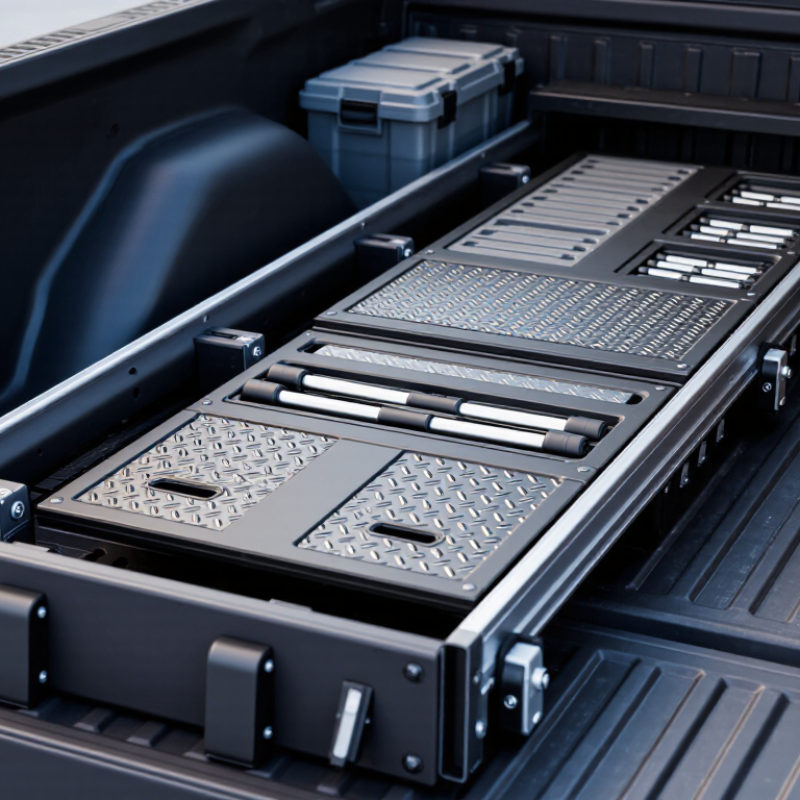
Define Pickup Bed Fit by Common 5.5-, 6.5-, and 8-Foot Bed Lengths
Pickup beds are commonly grouped as 5.5-, 6.5-, and 8-foot sizes, but these labels are not exact interior measurements. A 5.5-foot bed is roughly 66 inches long; a 6.5-foot bed, about 78 inches; and an 8-foot bed, about 96 inches. Measure from the front bed wall to the closed tailgate. Measure twice.
A pull-out cargo slide must fit the bed’s usable floor, not just its advertised length. Wheel wells, bed liners, tailgate trim, and mounting brackets can reduce available space. Check both the floor width between wheel wells and the width above them. Small details matter. A slide that is too long may obstruct the tailgate, while one that is too narrow can leave cargo awkwardly unsupported.
For a 5.5-foot bed, prioritize compact slide dimensions and confirm clearance with the tailgate shut. A 6.5-foot bed often allows more platform length, but verify the exact cab-and-bed configuration. An 8-foot bed can accommodate longer loads, though added slide length may increase weight and reach. Compare the slide’s closed and extended dimensions with your measurements, and check its load rating against typical cargo. It is tempting to choose the longest option available; that is not always the most practical fit.
Top 10 Pull Out Cargo Bed Slides for Buyers - Define Pickup Bed Fit by Common 5.5-, 6.5-, and 8-Foot Bed Lengths
Compare three common nominal pickup-bed length classes before selecting a pull-out cargo slide.
Lengths shown are nominal conversions: 5.5 ft = 66 in, 6.5 ft = 78 in, and 8 ft = 96 in. Actual interior dimensions vary by truck model and configuration. Measure the usable bed length and check the slide manufacturer’s fit specifications before buying.
Compare the Top 10 Slides by Published Load Capacity and Duty Rating
A useful top-ten comparison starts with the published load capacity, but the number alone can mislead. Record whether each rating applies to the complete slide or one component, and whether it assumes evenly distributed cargo. A 1,000-pound rating does not mean every loading pattern is safe. Check the test conditions, extension length, mounting hardware, and any stated dynamic-load limits. Some listings omit these details. That gap matters.
Duty ratings need equal scrutiny. Manufacturers may describe slides as light-, medium-, or heavy-duty, but those labels do not provide a universal cycle-life comparison. Look for a stated operating frequency, service class, or tested cycle count; mark missing information as “not published,” rather than guessing. FMCSA’s cargo-securement guidance, reflecting 49 CFR 393.106(d), requires aggregate tiedown working load limits of at least half the cargo weight. This is a securement benchmark, not a cargo-slide rating. Keep the two figures separate. A slide carries and supports cargo; tiedowns restrain it. Compare the ten options using published capacity, rating conditions, duty evidence, and installation requirements. Then match the choice to real use: tool cases near the tailgate, repeated daily pulls, or occasional weekend loading. A neat capacity table can still hide a weak assumption.
Top 10 Pull Out Cargo Bed Slides for Buyers - Compare the Top 10 Slides by Published Load Capacity and Duty Rating
Anonymous comparison of commonly published cargo-slide load ratings. Product and brand names are omitted; identical ratings may represent different configurations, so this is not a verified ranking of ten distinct products. “Duty class” is a capacity-based comparison label, not a standardized manufacturer rating.
| No. |
Anonymous slide rating profile |
Published maximum load |
Approx. metric equivalent |
Capacity-based duty class |
Buyer comparison note |
| 1 |
2,000-lb rating profile A |
2,000 lb |
907 kg |
Extra-heavy |
Compare the rated load with the slide’s own weight and the vehicle’s payload limit. |
| 2 |
2,000-lb rating profile B |
2,000 lb |
907 kg |
Extra-heavy |
Confirm whether the stated capacity applies to evenly distributed or concentrated loads. |
| 3 |
1,500-lb rating profile A |
1,500 lb |
680 kg |
Heavy |
A practical comparison point for substantial tools or equipment; verify installation requirements. |
| 4 |
1,500-lb rating profile B |
1,500 lb |
680 kg |
Heavy |
Check the permitted load while the tray is extended, not only when stowed. |
| 5 |
1,500-lb rating profile C |
1,500 lb |
680 kg |
Heavy |
Confirm bed-length compatibility and the required mounting surface. |
| 6 |
1,000-lb rating profile A |
1,000 lb |
454 kg |
Medium-duty |
Check whether the capacity is specified for static storage, movement, or both. |
| 7 |
1,000-lb rating profile B |
1,000 lb |
454 kg |
Medium-duty |
Allow for the combined weight of cargo, accessories, and any mounted equipment. |
| 8 |
1,000-lb rating profile C |
1,000 lb |
454 kg |
Medium-duty |
Review locking and retention features for the intended cargo and road use. |
| 9 |
1,000-lb rating profile D |
1,000 lb |
454 kg |
Medium-duty |
Compare extension travel and usable deck area alongside the load rating. |
| 10 |
1,000-lb rating profile E |
1,000 lb |
454 kg |
Medium-duty |
Verify the exact rating for the chosen size and installation before purchase. |
Load ratings are not directly comparable unless the test conditions, load distribution, installation, and extended-position limits are alike. Always consult the published specification for the exact slide configuration.
Check Extension Travel, Deck Width, and Tie-Down Compatibility
Top 10 Pull Out Cargo Bed Slides for Buyers
Check extension travel against the items you load most often. A slide that stops short may leave a toolbox or cooler awkwardly out of reach. Measure the bed’s usable length and width, including wheel-well pinch points. Then compare those figures with the slide’s deck dimensions, not just its overall frame size. Allow room for handles and latches. Small clearance errors can make a good-looking fit frustrating.
Tie-down compatibility matters as much as deck space. Check whether the slide’s anchor points remain accessible when it is extended, and whether straps can sit flat without rubbing sharp edges. For covered commercial loads, FMCSA’s 49 CFR §393.106(d) requires aggregate tiedown working load limits of at least 50% of cargo weight. Match your restraints and attachment points to the load; a slide’s stated capacity does not replace securement checks. Still, specifications can be easy to misread, so confirm what the manufacturer’s capacity rating includes.
Tips: Measure between the narrowest obstructions, then test strap access with the slide fully extended. Keep a little clearance. A paper fit is not always a real-world fit.
Assess Steel or Aluminum Construction, Corrosion Protection, and Weight
When comparing pull-out cargo bed slides, start with material weight and load rating. The ASM Handbook reports typical densities near 7.85 g/cm³ for carbon steel and 2.70 g/cm³ for aluminum. That difference can make an aluminum slide easier to extend, especially when the drawer is already loaded with tools. Lighter is not automatically stronger. Check the manufacturer’s rated capacity, fastener layout, and support spacing, not just the material name. A thin rail can flex under a concentrated load, such as a toolbox resting near its outer edge. Measure carefully.
Corrosion protection deserves equal attention. The American Galvanizers Association reports that zinc-coated steel can resist corrosion through a protective barrier and sacrificial action; coating thickness affects expected durability. For aluminum, inspect the finish and exposed cut edges, where scratches may leave the surface vulnerable to staining or pitting. ASTM B117 provides a controlled salt-spray test, but its results do not directly predict years of service outdoors. That limitation matters. Check whether test hours, coating details, and maintenance guidance are actually provided. A little uncertainty remains: real beds collect grit, water, and road salt in places a test chamber may not reproduce. Rinse the tracks and inspect fasteners regularly.
Review Installation Needs, Warranty Terms, and Replacement-Part Support
A cargo bed slide is useful only when it fits the truck and the work it must handle. Before comparing ten options, measure the bed’s usable length and width, including wheel-well intrusions. Check how the slide mounts, whether drilling is required, and if a helper is needed to position its frame. Measure twice. A slide that clears the tailgate when closed may still obstruct a tonneau cover or cab access when extended. Installation instructions should show mounting points, tool requirements, and safe load limits clearly.
Warranty terms deserve more than a quick glance. Check how long coverage lasts, which components it includes, and whether labor or shipping costs fall to the buyer. Ask how claims are handled if the slide binds, develops excessive play, or suffers damage during normal use. A long warranty sounds reassuring, but exclusions can make it less useful than expected. Read the actual terms.
Replacement-part support matters after the first season, when rollers, latches, or handles may wear. Look for a parts list with clear descriptions and an ordering process that does not depend on guessing measurements. Confirm that small components can be purchased separately, rather than requiring a full assembly replacement. Keep installation records and receipts. It is easy to overlook support until a simple broken latch leaves the slide awkward to use.
Conclusion
Choosing the right Pull-Out Cargo Bed Slides starts with matching the slide length to your pickup’s bed, commonly 5.5, 6.5, or 8 feet. Compare published load capacities and duty ratings with the weight and frequency of the cargo you expect to carry. Also check how far each platform extends, whether its deck width fits your bed, and whether its tie-down points work with your preferred cargo-securing setup.
Construction and ownership details matter too. Steel and aluminum offer different balances of strength and weight, while corrosion protection can help preserve the system through regular use and changing weather. Before deciding, review installation requirements, warranty terms, and the availability of replacement parts. Considering these factors together can help you choose a slide that fits your truck, cargo needs, and expectations for long-term use.